
Worksheet On Macromolecules
Worksheet On Macromolecules - These monomers, or single molecules, can be joined with other monomers to form larger units (polymers). Classify each as a/or part of a carbohydrate, protein, lipid or nucleic acid. These can be classified as __________. To begin using starbiochem, please navigate to:. How are organic molecules related to all living things? Macromolecules review worksheet part a.
Discover a collection of free printable resources for grade 10 students, designed to enhance their understanding of essential biological molecules. This worksheet is used with a unit on biological molecules in an introductory biology class. Classify each as a/or part of a carbohydrate, protein, lipid or nucleic acid. Carbohydrates, lipids, proteins and nucleic acids. Some terms may be used more than.
Monomers are repetitive units that form a larger compound. Our collection of complimentary printable macromolecules worksheets. To begin using starbiochem, please navigate to:. There are four classes of macromolecules (polysaccharides or carbohydrates, triglycerides or lipids, polypeptides or proteins, and nucleic acids such as dna & rna).
Macromolecule Worksheet 20202024 Fill and Sign Printable

Living organisms are made up of different macromolecules and inorganic Macromolecule worksheet explain how monomers are related to polymers. Macromolecules review worksheet part a. Investigate the major types of macromolecules, macromolecule bonds, and how our body uses them every day! To begin using starbiochem, please navigate to:.
14 Best Images of Biology Macromolecules Worksheets And Answers

For science teachers, here's an invaluable resource for class 9 students: There are four categories of organic molecules: Carbon is central to the structure of macromolecules because it can form up to four covalent. Classify each as a carbohydrate, protein, or lipid. This worksheet is used with a unit on biological molecules in an introductory biology class.
Macromolecules Worksheet PDF Macromolecules Polysaccharide

There are four categories of organic molecules: Carbohydrates, lipids, proteins and nucleic acids. Monomers are repetitive units that form a larger compound. How are organic molecules related to all living things? Carbohydrates (sugars for energy and.
Macromolecules Worksheet Biology Review

There are four classes of macromolecules (polysaccharides or carbohydrates, triglycerides or lipids, polypeptides or proteins, and nucleic acids such as dna & rna). Discover a collection of free printable resources for grade 10 students, designed to enhance their understanding of essential biological molecules. Classify each as a carbohydrate, protein, or lipid. Worksheet with answers on the macromolecules and how they.
50+ macromolecules worksheets on Quizizz Free & Printable
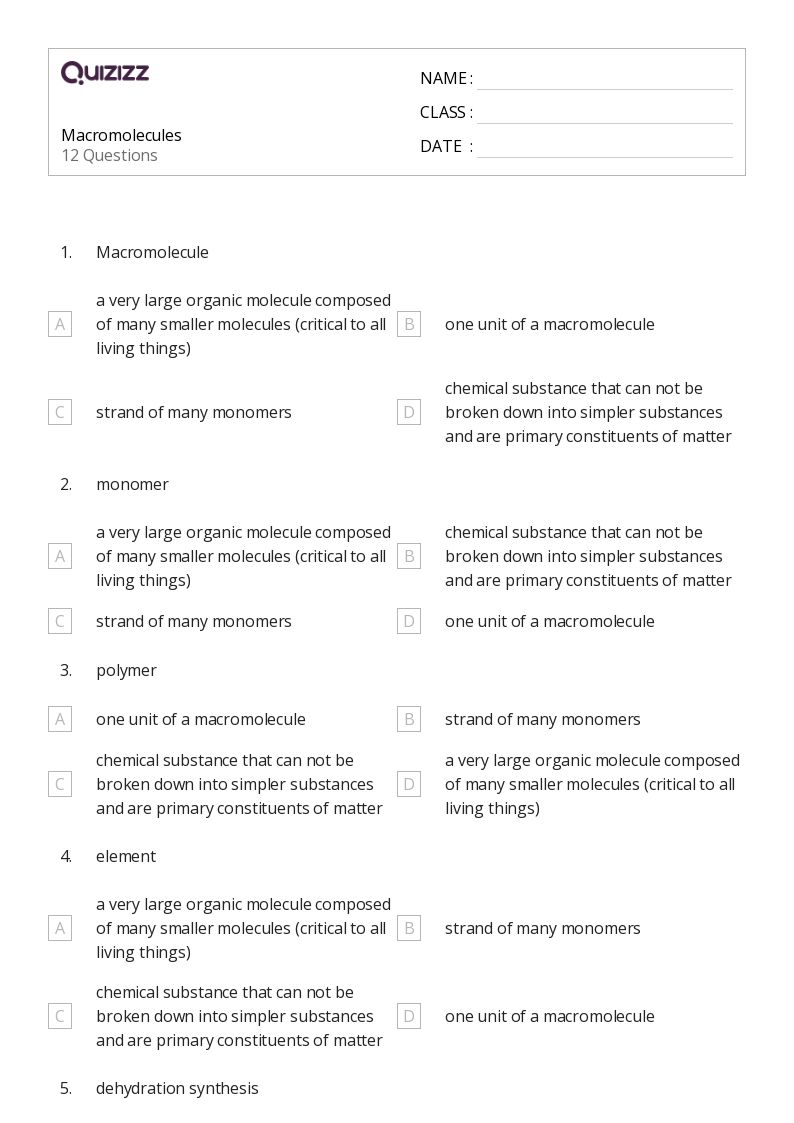
When polymers are broken down into monomers, what would your body do with those monomers? Identify the specific molecule (from part a) from each description. To begin using starbiochem, please navigate to:. There are four categories of organic molecules: This worksheet is used with a unit on biological molecules in an introductory biology class.
Macromolecules Review Worksheet Handmadefed

To begin using starbiochem, please navigate to:. Discover a collection of free printable resources for grade 10 students, designed to enhance their understanding of essential biological molecules. Macromolecule worksheet explain how monomers are related to polymers. Students match definitions or descriptions to words provided in a word bank. Worksheet with answers on the macromolecules and how they build organisms.
30++ Macromolecules Worksheet Answers Worksheets Decoomo

This worksheet is used with a unit on biological molecules in an introductory biology class. Elements that make up macromolecules. To begin using starbiochem, please navigate to:. Students match definitions or descriptions to words provided in a word bank. Worksheet with answers on the macromolecules and how they build organisms.
Worksheet On Macromolecules - Start your lesson off with this exploratory. Identify the specific molecule (from part a) from each description. Carbohydrates, lipids, proteins and nucleic acids. Living organisms are made up of different macromolecules and inorganic Monomers are repetitive units that form a larger compound. Elements that make up macromolecules. Some terms may be used more than. To begin using starbiochem, please navigate to:. Discover a collection of free printable resources for grade 10 students, designed to enhance their understanding of essential biological molecules. The most common simple sugars are glucose, galactose and fructose that are made of a single sugar molecule.
Living organisms are made up of different macromolecules and inorganic Worksheet with answers on the macromolecules and how they build organisms. These monomers, or single molecules, can be joined with other monomers to form larger units (polymers). Dive into the intriguing domain of. Carbon is central to the structure of macromolecules because it can form up to four covalent.
Carbohydrates (Sugars For Energy And.
This worksheet is used with a unit on biological molecules in an introductory biology class. Start your lesson off with this exploratory. There are four categories of organic molecules: Students match definitions or descriptions to words provided in a word bank.
Living Organisms Are Made Up Of Different Macromolecules And Inorganic
Classify each as a/or part of a carbohydrate, protein, lipid or nucleic acid. Macromolecule worksheet explain how monomers are related to polymers. Dive into the intriguing domain of. Macromolecules review worksheet part a.
Monomers Are Repetitive Units That Form A Larger Compound.
These monomers, or single molecules, can be joined with other monomers to form larger units (polymers). They can be divided into four groups: For science teachers, here's an invaluable resource for class 9 students: Our collection of complimentary printable macromolecules worksheets.
Carbon Is Central To The Structure Of Macromolecules Because It Can Form Up To Four Covalent.
To begin using starbiochem, please navigate to:. Carbohydrates, lipids, proteins and nucleic acids. Some terms may be used more than. Classify each as a carbohydrate, protein, or lipid.